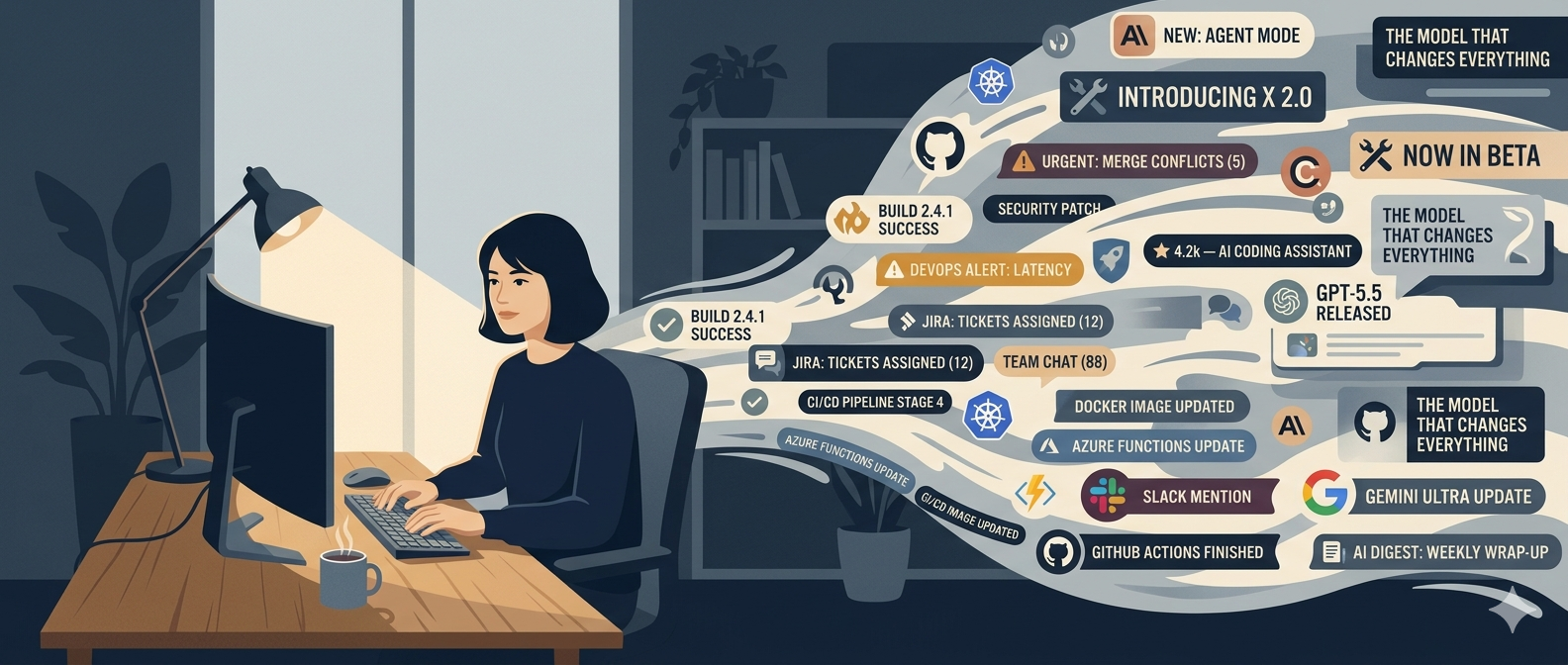
Another one dropped today.
You saw the announcement, opened the thread, and felt that familiar pull – the mix of curiosity and quiet dread. Should I be trying this? Is this the one that changes things? Am I already behind?
A few hours later you’ve got three new tabs open, a half-formed opinion, and nothing actually done. It might be great. You might try it next week. Or you might see the next announcement before you get there, and start the whole thing over.
If that loop sounds familiar: you don’t have a keeping-up problem. You have a clarity problem.
They feel exactly the same from the inside. Both come with the same low hum of anxiety. But they have completely different fixes – and confusing the two is why most advice about “managing AI tool overload” doesn’t actually help.
This is what the clarity problem looks like, why it’s harder than it sounds, and what to do about it.
The treadmill
According to ActivTrak’s 2026 workplace data, organisations are now using an average of seven AI tools – up from two just a couple of years ago. That same report found focus efficiency at a three-year low. And nearly half of developers report experiencing what researchers are now calling “AI fatigue” – a tiredness that’s different from just being overworked.
That last number doesn’t surprise me. What’s different about this cycle isn’t just how much is coming – it’s how fast. The JavaScript framework wars of the 2010s moved on a timescale of months. A new AI capability now lands every few days, and each one arrives with its own wave of takes, tutorials, and implicit pressure to have an opinion.
And it’s not just standalone tools. There are feature drops inside tools you already use – Claude Code ships meaningful new capabilities nearly every week, and the same is true of most major AI products. Below that, there’s a third layer: community repos, plugins, skill libraries, and integrations that extend those tools further. Three fronts, all moving at once.
The treadmill isn’t metaphorical. It has a measurable cadence. Tools ship in permanent beta, with APIs that change week to week and features deprecated before you’ve had time to form a real opinion. The announcement is engineered for reach. The actual product often isn’t ready for a considered evaluation – but the pressure to evaluate it lands anyway.
This matters because a lot of advice in this space treats the problem as personal. You need better habits. A better reading list. More disciplined attention. But the pace isn’t imagined, and the pressure isn’t irrational. There’s genuinely a lot coming in, and it keeps increasing. Responding to it is a reasonable thing to do.
The problem isn’t that you’re feeling the pull. The problem is why that pull feels so much heavier now than it did during any previous wave of tooling.
Why it actually exhausts you
Part of it is purely mechanical. Every release you evaluate requires a context switch: read the docs, watch the demo, form an opinion, compare it to what you’re already using. Context-switching has a compounding cost that’s easy to underestimate. You don’t just lose the minutes you spent evaluating – you lose the recovery time after, and the fractured attention that bleeds into everything around it.
But the deeper exhaustion isn’t mechanical. It’s the signal embedded in the announcement itself.
The marketing around AI tooling doesn’t say “here’s something you might find useful.” It says: the developers who adopt this will be faster, smarter, and more competitive than the ones who don’t. Sometimes that’s implicit – a thread full of jaw-dropping demos, colleagues mentioning they’ve already integrated it. Sometimes it’s explicit: “10x your output,” “ship 40% faster.”
That framing turns every release into a performance review you didn’t ask for. Not adopting starts to feel like a decision to fall behind. Harvard Business Review recently named this specifically – the cognitive strain of constantly deciding what AI work is worth doing and whether you’re keeping up. They called it “brain fry.” It’s a real, documented phenomenon, not a personal quirk.
This is why this wave hits differently than previous ones. A new JavaScript framework was annoying to evaluate. A new AI release carries the implicit question: if I don’t use this, will I become irrelevant? That’s a much heavier thing to dismiss.
You’re not tired because you’re bad at managing your attention. You’re tired because every release is asking you a question about your future.
The misdiagnosis
When people feel overwhelmed by this, the usual prescription is curation. Subscribe to a good newsletter. Build a better reading list. Use an aggregator. Let someone else filter the firehose before it reaches you.
It’s a reasonable instinct. And for pure information overload – too much noise, not enough signal – it would work. But the problem most developers are actually facing isn’t information overload. It’s relevance confusion.
Information overload means you have too much to process. Relevance confusion means you can’t confidently discard anything, because you don’t know clearly enough what you need. When you don’t know what you need, a better filter doesn’t help – it just gives you a smaller pile of things that all still seem potentially important.
This is what I kept running into. I’d subscribe to a curated AI newsletter, skim it, and still feel the pull on every item. Not because everything was important – most of it wasn’t – but because I had no quick way to judge whether it was important to me. Without that, the default is to treat everything as a candidate.
The METR research team published a study looking at how experienced open-source developers actually performed with early-2025 AI tools. The results were striking: for the kinds of complex, judgement-heavy work experienced developers do most of the time, the tools didn’t reliably help. Most of what ships won’t help most developers, most of the time – most releases aren’t going to move the needle for most developers, most of the time. Good curation can’t fix that, because the problem isn’t the stream. The problem is not knowing what you’re fishing for.
The solution isn’t a better filter for what comes in. It’s being clear enough about what you need that you can apply your own filter – and actually mean it.
The filter
So what does that clarity look like in practice?
For the past months I’ve been running every new AI release (model, feature, skill,…) through two questions before I spend any real time on it. They take about thirty seconds to answer. Between them, they’ve saved me tons of hours of evaluation that would have produced nothing useful.
The questions:
1. Can I name a specific problem I’m working on right now that this addresses?
Not “could I imagine this being useful someday.” Not “other people seem to be finding this valuable.” A concrete, current problem – the kind where I can finish the sentence: “I keep running into X when I’m doing Y, and this might help because…”
If I can’t finish that sentence, I don’t evaluate it. I file it – a bookmarks folder, a notes list, wherever – and move on. If the problem eventually shows up in my real work, I go back. Most of the time I never do.
2. Am I willing to give this a real week?
Not an afternoon. Not a demo. A week of actual use in actual work – long enough to get past the tutorial and into the friction, where you find out whether the thing is genuinely useful or just impressive in controlled conditions. If I’m not willing to do that, I’m not willing to form an honest opinion. Which means any evaluation I do will be shallow and probably wrong.
If the answer to question 2 is no, that’s useful information. I’m not ready. I file it and move on.
The counterargument I hear is: but what if you miss the next genuinely transformative tool? My experience is the opposite. The releases that actually matter clear both questions immediately. When something lands that addresses a real current problem and you’re immediately willing to commit time to it – you know. The filter doesn’t block those – it surfaces them from the noise.
The signal finds you, if you know what signal you’re looking for.
The company problem
I’ve seen this play out with clients too, and it’s the same problem at a larger scale.
Companies under pressure to “stay ahead of AI” tend to end up in the same loop: evaluate everything, commit to nothing. Deloitte’s State of AI research found that only 15% of organisations are fully prepared to scale AI initiatives. The rest are stuck in pilots – not because the tools don’t work, but because adoption without clear criteria creates organisational drag that builds faster than the tools can clear it.
The research is consistent: companies that try to evaluate every release don’t move faster, they move less. Trying to cover everything fragments attention across an organisation the same way it fragments it across an individual’s week.
The same two questions apply at this scale. What specific problem are we actually trying to solve? Are we prepared to invest what it genuinely takes to find out if this works? If the answer to either is unclear, you’re not ready to adopt. And adopting anyway doesn’t make you more prepared – it just makes you busier.
Conclusion
The goal was never to know every tool, every feature drop, every update. It was to stay effective.
Somewhere along the way those two things got conflated – probably around the time AI marketing started framing adoption as a performance metric. But they’re different. Knowing about something is not the same as using it well. Using it badly, or too early, or without a real problem to point it at, is often worse than not using it at all.
Not keeping up is a strategy. It’s a deliberate choice to spend your attention on work that has a clear target, rather than on evaluation that doesn’t. It means you’ll occasionally miss something that would have helped – and you’ll also skip past dozens of things that wouldn’t have. That’s a good trade.
The next announcement will land tomorrow. You don’t have to open it. You don’t have to have an opinion. If it doesn’t answer your two questions, it’s not for you – not right now, and maybe not ever.
That’s not falling behind. That’s staying focused.
Sources
- https://hbr.org/2026/03/when-using-ai-leads-to-brain-fry – HBR piece on AI-driven cognitive strain
- https://hbr.org/2026/02/ai-doesnt-reduce-work-it-intensifies-it – HBR on work intensification post-AI adoption
- https://clearing-ai.com/stats.html – AI Fatigue Statistics 2025: 48% of developers experience AI fatigue; 60–75% report stress/reduced satisfaction
- https://www.functionize.com/blog/systematic-vs-selective-ai-adoption – Systematic vs. selective adoption framing
- https://dev.to/teamcamp/the-hidden-cost-of-developer-context-switching-why-it-leaders-are-losing-50k-per-developer-1p2j – context switching costs $50K+ per developer per year
- https://metr.org/blog/2025-07-10-early-2025-ai-experienced-os-dev-study/ – METR study: experienced devs didn’t see productivity gains from early-2025 AI tools
- https://www.buildmvpfast.com/blog/ai-fatigue-tool-overwhelm-developer-counter-trend-2026 – developer-focused piece on AI tool overwhelm as a named counter-trend in 2026
- https://www.activtrak.com/resources/state-of-the-workplace/ – 2026 State of the Workplace: organisations using avg 7 AI tools (up from 2)